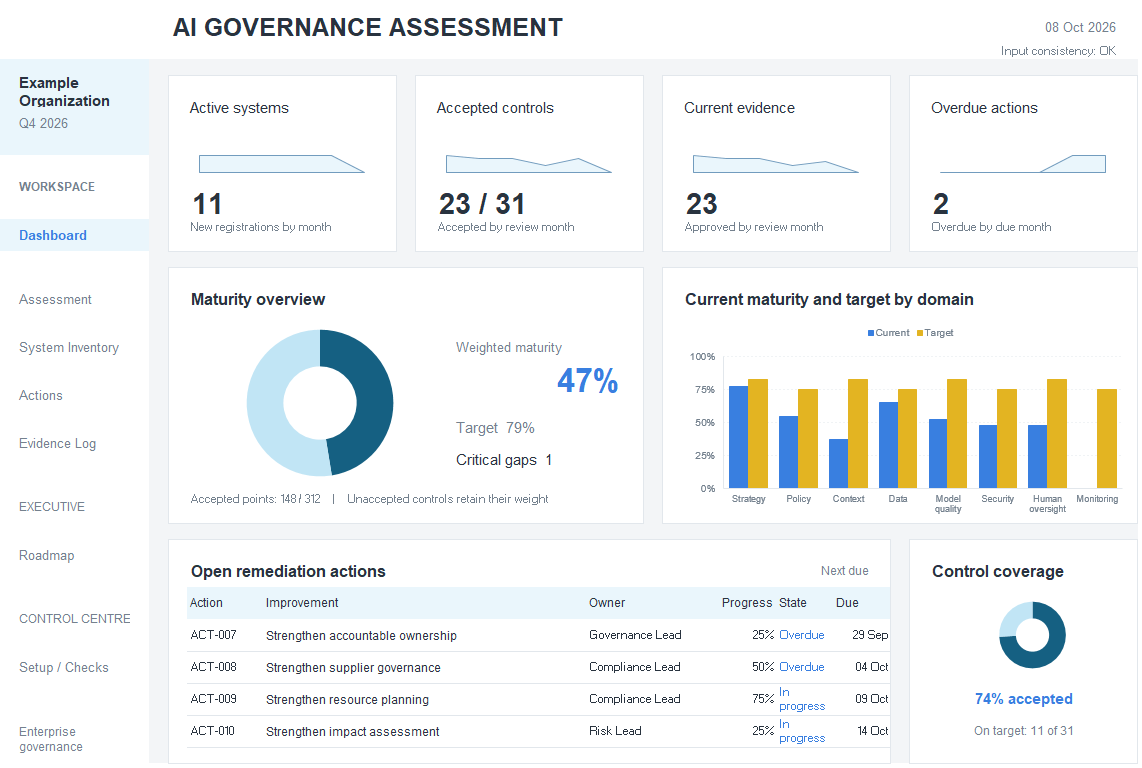
An AI governance assessment examines who may introduce, change, monitor or stop an AI use case and what evidence those people need. A model evaluation can reveal errors, while the governance assessment tests whether anyone has the authority and information to act on them. Frame the assessment around one proposed use and its real operating setting.
Describe the decision the system influences
Record intended use, prohibited uses, affected people, input sources, supplier dependencies, human reviewer and accountable sponsor. Describe whether the output suggests, ranks or determines an outcome. An employee’s power to override a recommendation matters only if they can recognize an error, have time to review it and have a usable alternative process.
Ask the sponsor to specify approval criteria, escalation channels and conditions that trigger suspension. Assign an owner to monitor changes in the population, supplier model or user workflow. The NIST AI Risk Management Framework and its Playbook provide voluntary guidance for organizing this review.
Set a boundary on multilingual service routing
Consider a pilot that recommends the team to handle customer messages. In a test of 240 messages, reviewers find eight misrouted cases among 200 messages in one language and six among 40 in another. The observed misrouting rates are 4% and 15%. The smaller group warrants further investigation, including whether the test messages reflect the real range of requests.
Suppose the sponsor had set a 10% misrouting threshold for each tested language. The panel keeps manual routing for the second group and asks for a broader evaluation. It records the owner, acceptable evidence for reopening and who can pause the pilot if live incidents increase. Service staff receive instructions for correcting a route and reporting recurring errors.
Revisit the decision when the system changes
Link the governance decision to the AI risk assessment that examines failure scenarios and impacts. Record exceptions and changes to scope. Confirm that the team can locate and exercise the stop procedure during a rehearsal. Where legal classification or related obligations matter, assign a separate review using the EU AI Act checklist with the organization’s appropriate advisers.