An AI risk assessment starts with a specific use, an affected group and a decision someone can stop or reverse. “Use AI in customer support” is too broad to test. A more workable scope is a routing assistant that suggests which queue receives a new support ticket while a trained agent makes the final choice. Name who can override the suggestion and what happens if the tool is unavailable.
Test the mistake that matters
Suppose a team evaluates 100 previously resolved tickets. Reviewers agree with the suggested queue on 92. Twelve tickets in the set concern urgent account access, and three of those go to an ordinary queue. The overall agreement is 92 percent. The observed routing error for the urgent subset is 3 of 12, or 25 percent. The two figures answer different questions. A small, deliberately selected test set also limits what the team can conclude about future tickets.
Record how reviewers established the reference labels, how ambiguous cases were handled and whether the test contains the languages and request types expected in production. Track the impact of an urgent error in hours of delay. Keep examples used for evaluation under appropriate access and retention controls.
Define a bounded pilot
For this use, supervisors might require a human to review all urgent candidates, set aside time to inspect a selection of ordinary-queue tickets and pause the pilot if a confirmed urgent ticket exceeds the agreed waiting time. Assign the person authorized to pause, a fallback route for new tickets and a method to find messages already waiting.
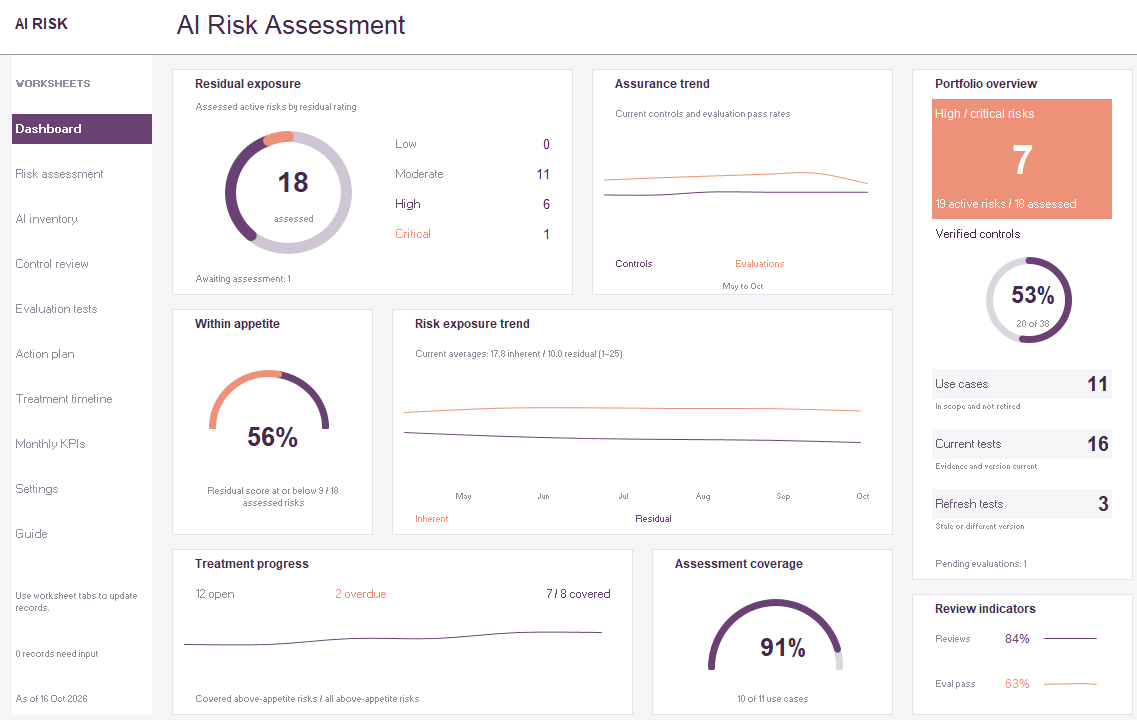
Use the AI governance assessment to document deployment approval and the review owner. A key risk indicator dashboard can show urgent misroutes alongside reviewed volume and time to correction. Reassess when the model, ticket mix, routing labels or human review capacity changes. An unchanged overall score can conceal a newly unreliable queue.