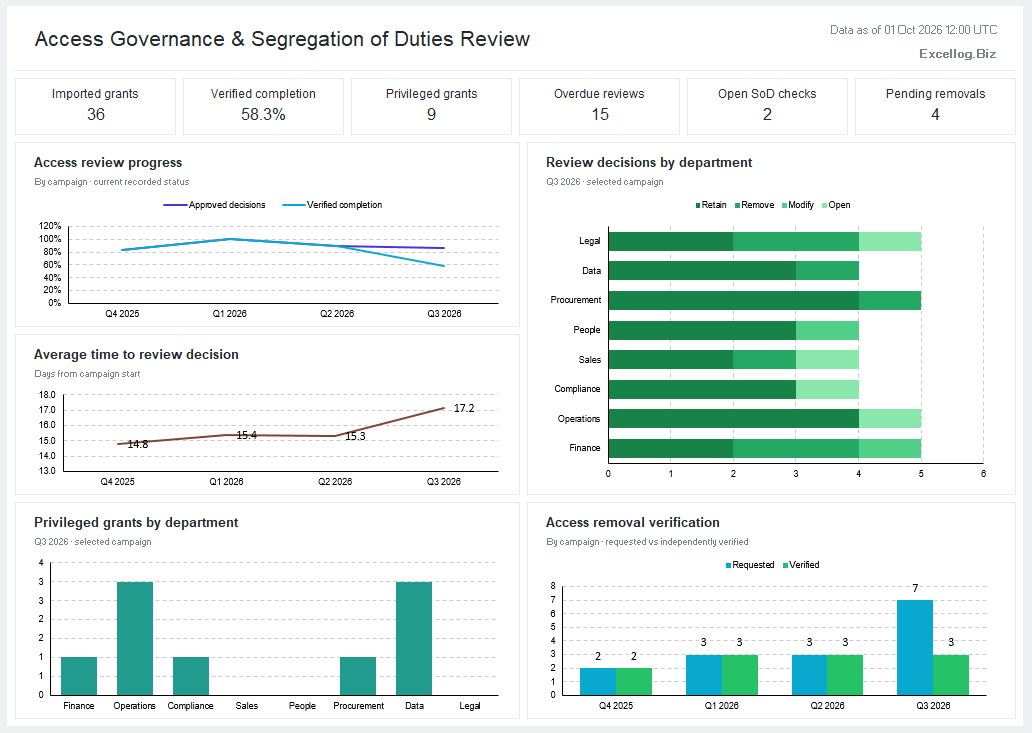
An access governance and segregation of duties review establishes whether each person still needs their access and what their permissions allow in combination. Reviewing a list of job titles answers neither question reliably. Two employees with the same title can inherit different permissions through group membership, temporary cover or direct grants.
Build a population a reviewer can explain
Pick a business workflow and specify its systems, organizational units and snapshot time. Gather account identifiers, person or service owner, employment status, role memberships, direct grants and application-level scope. Reconcile the export to the source account count. Where a trusted service has no individual user, identify the business owner and what can act through that service.
Translate technical entitlements into recognizable activities. Ask process owners to approve the conflict rules in the segregation of duties matrix and tell reviewers which business unit, transaction type or approval limit changes the outcome. Protect user-level reports and retain only the evidence needed for review.
Investigate a supplier administrator with temporary cover
Imagine 42 finance accounts across two branches. Three people appear able to maintain suppliers and approve payments. One holds the activities in different entities with enforced boundaries. Another inherited a payment role during leave cover that ended six weeks earlier. The third is a branch supervisor with an approved temporary arrangement and independent bank-change checks.
Record the reasoning separately for each person. Validate the entity boundary for the first account. Remove the expired assignment from the second and capture a fresh effective-permissions report. For the third, verify the approval, expiry and evidence that an independent person performed the compensating check. A manager’s bulk approval would hide all three different outcomes.
Verify remediation on a fresh snapshot
A completed service ticket records that someone took action. Check that the effective ability disappeared across every grant path. Link unresolved exposures to the risk acceptance decision or a dated remediation action, as appropriate. At the next review, compare resolved findings with new access grants so a recurring temporary role cannot quietly reintroduce the conflict.