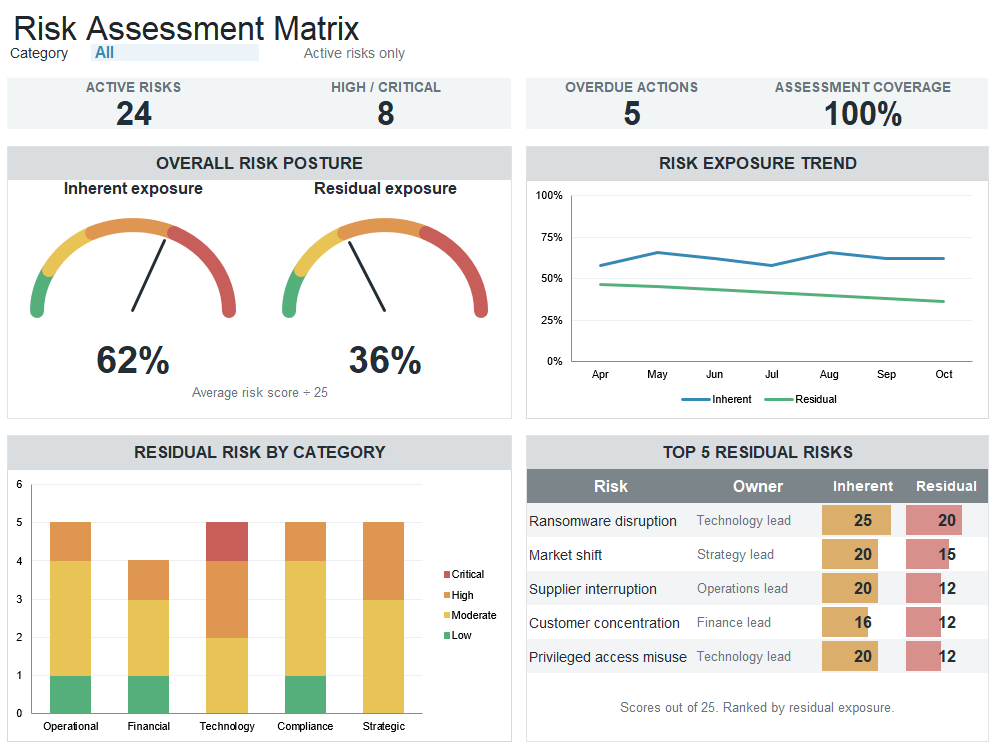
A risk assessment matrix helps reviewers place scenarios on agreed likelihood and consequence scales. It works best when different people can explain why a scenario belongs in a given cell. Put the time horizon, unit of exposure and scale definitions beside the ratings. A label such as “frequent” will mean different things for a weekly payment run and a once-a-year migration.
Calibrate with cases the team recognizes
One facilities team uses four likelihood levels for the next year and four impact levels based on service interruption. In its local scale, the top impact level means loss of a critical service beyond an entire working day. Decide how a customer impact or safety concern crosses a boundary even when the direct financial cost is low. Agree on the escalation rules before scoring a disputed event.
Compare two cells with the same score
Suppose a common printer interruption receives likelihood 4 and impact 1. A much less likely central booking interruption receives likelihood 1 and impact 4. If the team multiplies the ratings, each produces 4. Yet the booking interruption could leave the service closed for a day, while a print failure can be handled locally. Keep the two coordinates visible and route top-impact events to the service owner for review. The product of ordinal labels is a prioritization convention and gives no estimate of expected cash loss.
Retain the scenario, evidence date, rationale, control assumptions and reviewer in each row. Ask a second reviewer to score a few cases independently. Where they disagree, compare the definition of the consequence and the horizon they assumed before taking an average or voting.
Preserve the reason for a change
If a tested workaround shortens a booking interruption, enter the evidence and reassess the consequence. Record why the likelihood might stay the same. Check an escalation against the agreed appetite boundaries and use scenario analysis for an event whose duration changes the decision more than its matrix color.