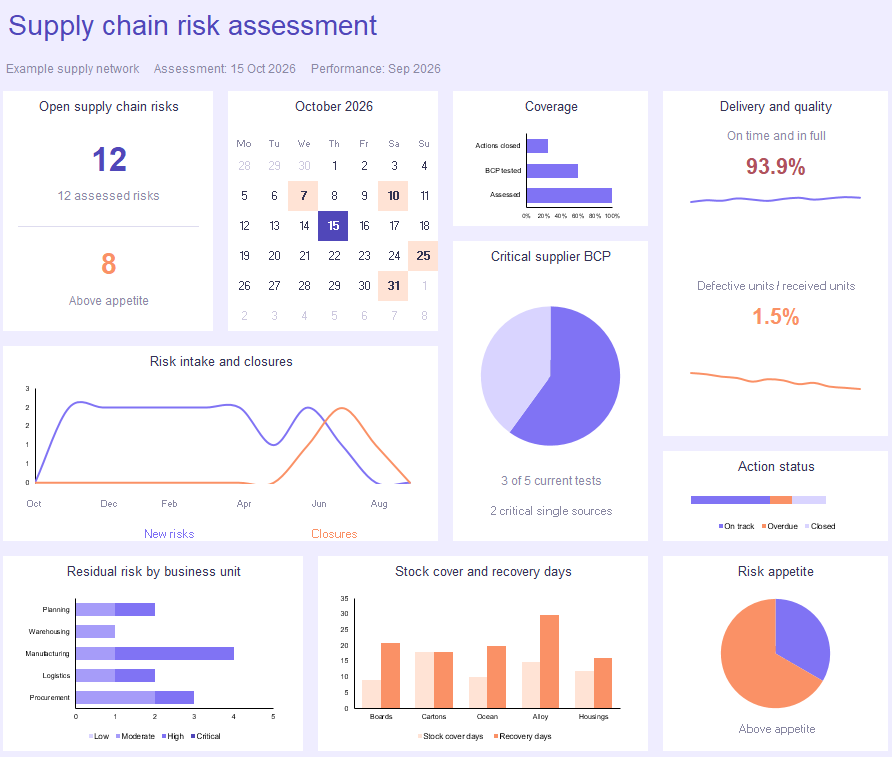
A supply chain risk assessment traces how a disruption at a supplier, location or transport route could affect a product or service. Start with a single deliverable and its critical inputs. Give each input an owner who can verify the tier-one supplier, upstream source, replenishment time, usable stock and restrictions on substitution.
Test apparent diversification
Two different supplier names on a purchase ledger can lead back to the same factory or logistics hub. Ask for the manufacturing location, relevant subcontractors and route for the specific item. Record what remains unknown and how you could verify it. If a substitute needs engineering approval, include the approval and production time in the lead-time estimate.
Map consequences for workers and communities as well as delivery consequences where relevant. The OECD guidance provides a separate basis for examining adverse impacts associated with a company’s operations and business relationships. Keep the people affected and the evidence for their concerns visible when prioritising actions.
Measure the gap in available cover
A pump manufacturer consumes 40 certified seals each working day. It has 320 usable seals, giving eight working days of cover at current demand. Its two distributors both source from one plant. A qualified supplier at a different plant can deliver in 12 working days from confirmed order. Assuming unchanged demand and no new deliveries in between, the planning gap is four working days, or 160 seals.
The purchasing lead requests a firm production slot from the alternate supplier. The planner tests an allocation of existing stock to service-critical orders while quality confirms the substitute part number. The reviewer records the assumptions about demand, existing reservations and what counts as usable stock. Recalculate after the next inventory count.
A promise to deliver still leaves exposure until the team validates dates and qualification. Preserve the supplier evidence in third-party due diligence and transfer the capacity test to the continuity assessment so both reviews use the same recovery assumption.