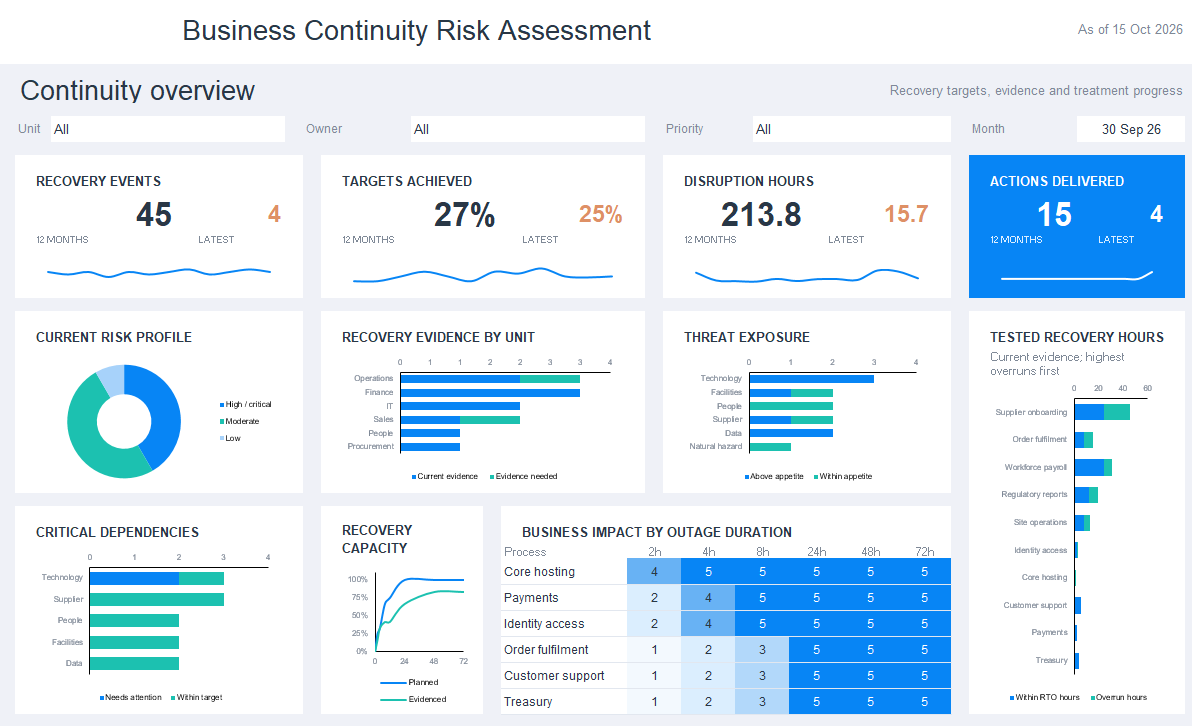
A business continuity risk assessment examines what might interrupt a priority service and whether the planned recovery arrangements would work. Take the minimum acceptable service and timing from the business impact analysis. Check the people, facilities, data, equipment and external providers needed to maintain that level during the disruption.
Test the quantity behind the recovery promise
Avoid settling for a statement that an alternative location is available. Ask how many trained staff it can seat, which records they can access, who can authorise exceptional transactions and how much work each person can complete under exercise conditions. Compare the resulting capacity with demand over time. Capture the evidence for each estimate and the unresolved dependencies.
Check the handover as well as the fallback. The team may need to reconcile manually completed work with restored systems, correct duplicates and inform customers about delays. A short exercise that ends when an operator signs in can miss most of this workload.
Work out the shortfall in one shift
A distributor processes 90 urgent order lines per hour during its busiest shift. Its documented fallback allows three trained operators to handle 20 lines each per hour. If normal processing stops for four hours, orders arrive at a steady rate and the fallback begins immediately, the team accumulates 120 lines of backlog. A missing first-hour contact or a peak in demand makes that estimate worse.
The service owner proposes a fourth operator and prioritisation rules for time-sensitive orders. Four operators would handle 80 lines per hour under the same assumptions, leaving a smaller backlog. The owner schedules an exercise that starts with an unannounced handover, samples the accuracy of manual entries and times how long reconciliation takes after restoration.
Record the accepted service level, the decision maker and the evidence still needed. Use the risk treatment plan to fund the changes and the workplace safety assessment to check the proposed fallback location with the people who will use it.