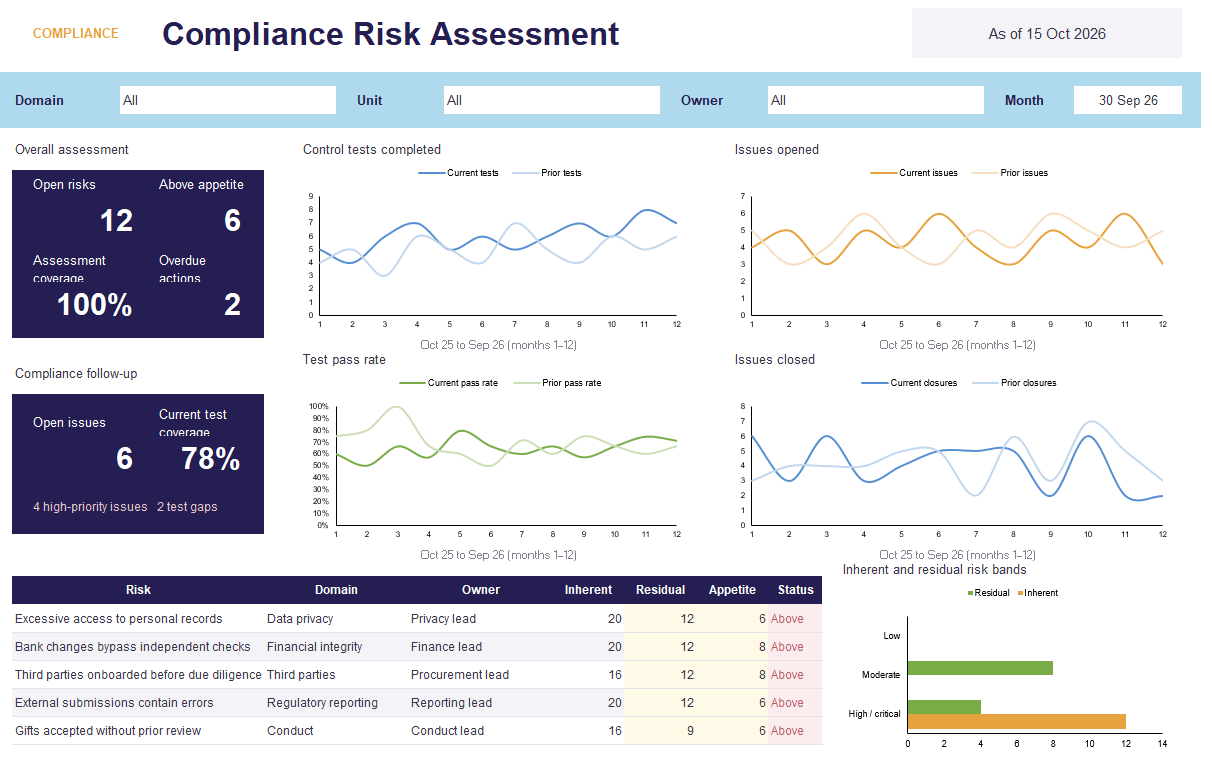
A compliance risk assessment asks how an organisation could fail to meet an applicable requirement and what that failure would mean for affected people and the business. Start with a clearly identified duty. Record its source, where it applies and who has confirmed the interpretation. The obligations register is a useful source for this context.
State the failure in operational terms
A broad label such as “reporting risk” gives a reviewer little to test. A more useful statement describes a particular report, the trigger for producing it, the deadline and the process that could miss it. Consider volume, exceptions, changes to the process and the quality of available evidence. State the reasoning behind likelihood and impact so colleagues can challenge an assumption without arguing about colours.
Distinguish a control that exists on paper from evidence that it operated through the period. A procedure may describe two levels of review even though an exception route bypasses the second review. Set down what population you tested and how you identified exceptions.
Work through a contract reporting commitment
A distributor has agreed to send a service report within five business days of month end for each of 12 regional accounts. Two of the 12 reports went out after the contractual date last month. Both accounts transferred to a new reporting team. The owner checks the dispatch log and finds the handover list omitted their new contacts. A sample of long-standing accounts would have missed the gap.
The commercial manager assigns account operations to add contact verification to the handover and review the next two month ends. The analyst records the two misses in the breach process, subject to the organisation’s agreed definition, and uses the control testing tracker to retain evidence of the change. If both cycles complete on time, the reviewer reassesses the remaining exposure and documents why. Keep the history of the two misses available when the contract is renewed.