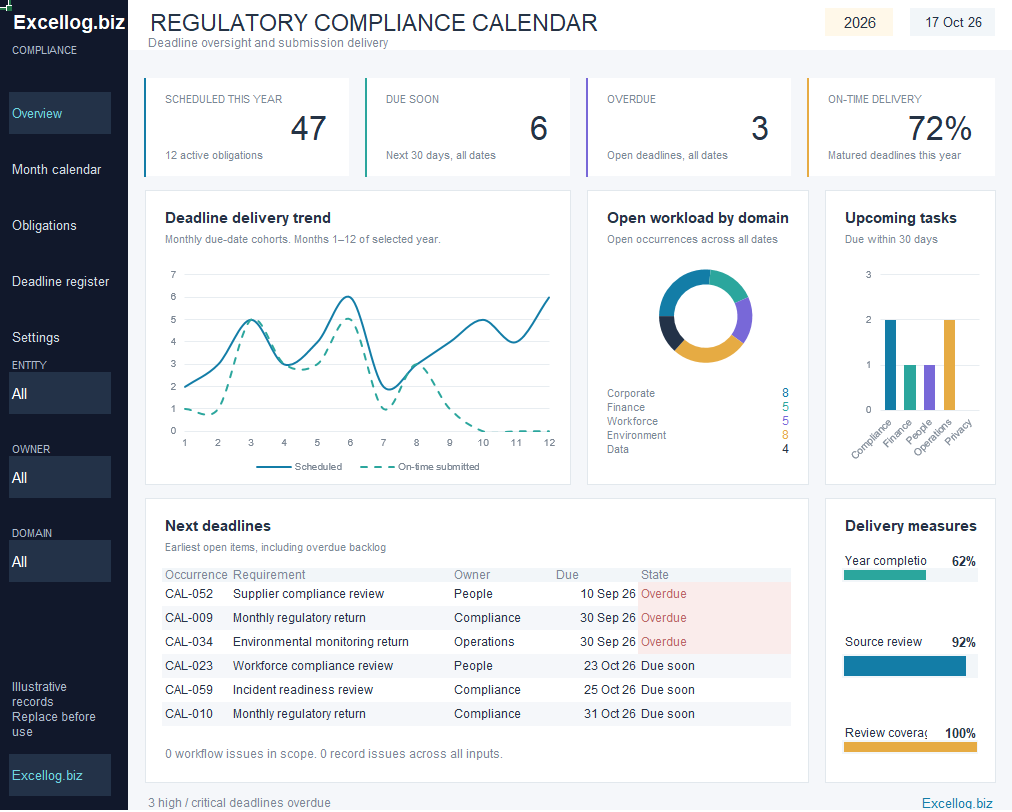
A regulatory compliance calendar is the team’s working schedule for filings, renewals, attestations and reviews. Its value becomes clear when a filing owner is absent and a colleague has to finish the task. A useful entry gives that colleague the source of the obligation, the deadline calculation, the required inputs and a practical definition of completion.
Work backward from an external deadline
Start with a confirmed obligation from the compliance obligations register. Record the legal entity, recipient, reporting period, time zone and applicable rule on weekends or holidays. Capture the due date under that rule and assign internal dates for collecting data, reviewing the return and authorising submission. Record recurring rules in words and check several actual dates. Event-driven obligations need a trigger, a timestamp and an owner who watches for the event.
Give the backup owner a complete filing route
Consider a quarterly statistical return due under an illustrative reporting instruction on the fifteenth working day after quarter-end. The finance analyst prepares it, the operations head approves it and a deputy can submit it through the designated portal. The calendar entry names the source report and approved alternate submitter. It also identifies the receipt the portal produces. If the analyst finishes early but the portal rejects the upload, the return stays open. Record the rejection, the person resolving it and time remaining to the external deadline.
A rehearsal can expose simple dependencies. Ask the deputy to locate the current form, identify who can approve it and find the last acknowledgment. If the answer depends on reading someone else’s inbox, move the evidence reference into an access-controlled team location.
Review by exposure to a missed deadline
Each week, filter for items approaching the internal cutoff with missing data, approvals or portal access. A filing due next month may need attention sooner than one due tomorrow if obtaining its inputs takes several weeks. Record rescheduled dates with the reason and approving authority. If an external deadline is missed, send the facts for assessment through the compliance breach register and keep the original deadline visible for review.