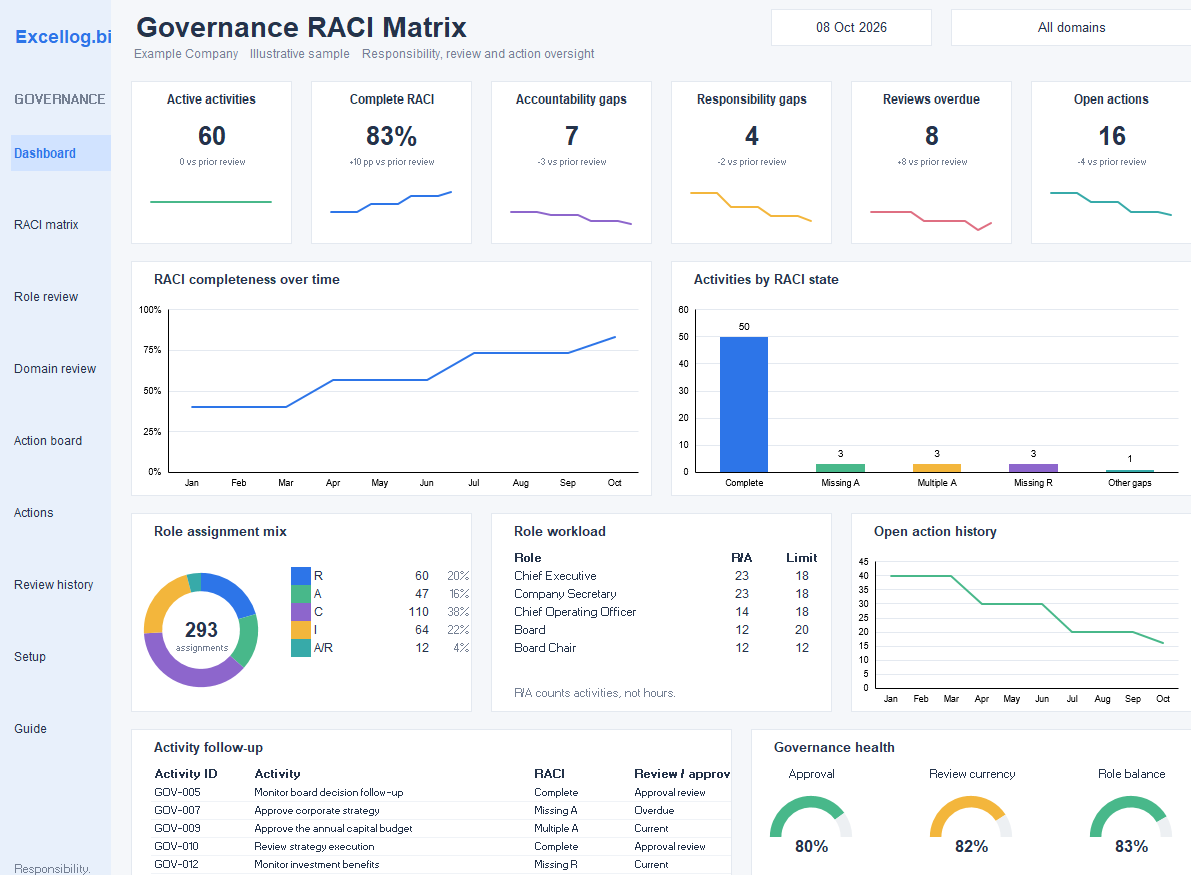
A governance RACI matrix helps a team agree who produces an output, who answers for it, whose input must arrive before completion and who needs the outcome. Its value becomes visible at handoffs. A policy can wait a week for “management approval” while three people each assume the other two own the decision.
Name the output in each row
Start with a verb and an observable result. “Prepare the policy draft,” “authorize publication” and “notify affected teams” clarify responsibilities better than a single row labelled “policy governance.” Put roles across the columns so the map survives staff changes. Define Responsible, Accountable, Consulted and Informed once and give participants a worked row.
A practical design uses one accountable role for each output. Where a committee has formal authority, identify the committee and record the role that administers its decision. Review any row with no responsible person or many consultees. Define a response deadline and a route for unresolved objections.
Map a policy launch after a missed handoff
Suppose a procurement policy was approved on Monday but buyers kept using the old thresholds for five working days. The policy owner had assumed the approver would update the purchasing portal. The approver thought publication belonged to operations. Split the row for approval from the row for release.
For release, the procurement operations lead is accountable, the portal administrator is responsible, the policy owner checks the effective wording and branch buyers receive notice. Completion evidence includes the new portal version and confirmation that old quick-reference sheets have been withdrawn. Link the release to its entry in the policy management register.
Rehearse an exception
Ask the team to route a request that arrives during the accountable manager’s absence. If an alternate can coordinate the work but cannot authorize the amount involved, check the delegation of authority matrix. Revisit the RACI after a restructure or failed handoff. Comparing a real case with the agreed row reveals gaps that signatures on a draft rarely expose.