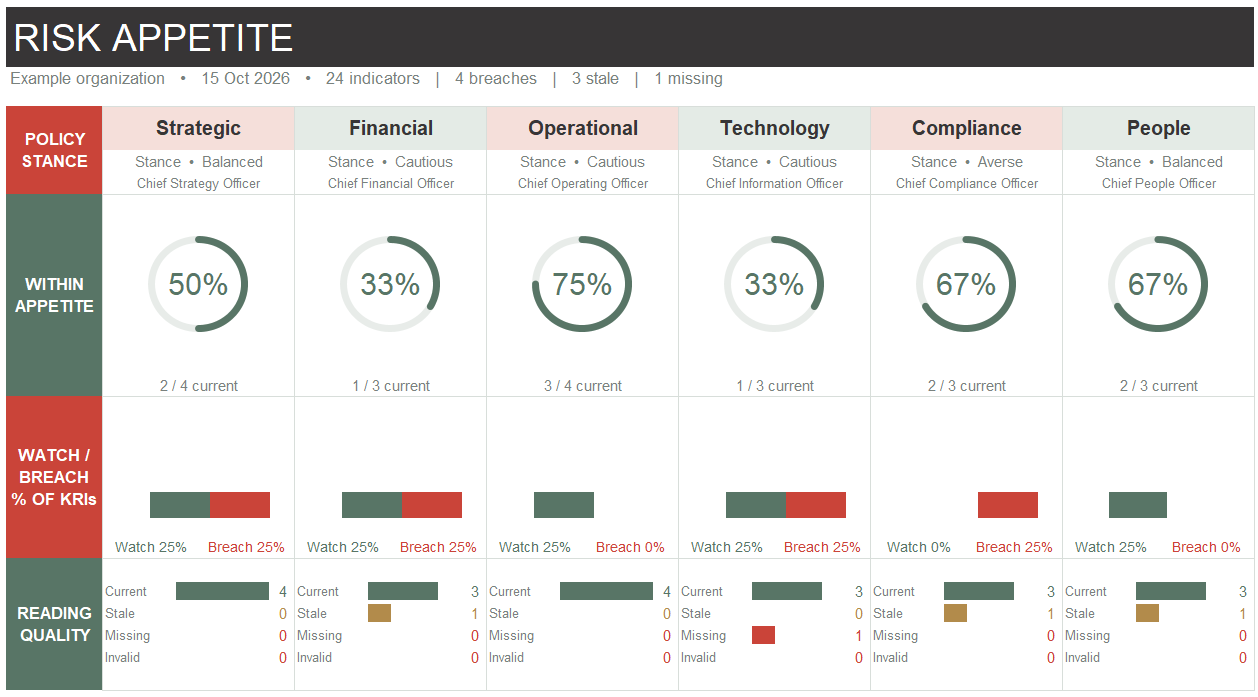
A risk appetite matrix helps a team interpret what leadership is prepared to take on in pursuit of an objective. Broad statements such as “limited appetite for disruption” leave an opening for different decisions during a busy month. Add an operating measure, where it is observed, who reviews it and which action follows a threshold crossing. The boundaries need approval from the people who own the objective.
Specify how to reproduce the measure
For supplier concentration, define the denominator and the period. Spend across all suppliers may hide reliance on a specialist provider within one critical service. A useful row could measure appointments in the next four weeks that depend on a single external provider, divided by all booked appointments in that service. Identify the scheduling report, the person who extracts it and the date at which the forecast becomes reliable. Include a route for cases where the report is incomplete.
Work through a boundary crossing
Suppose a clinic network accepts up to 30 percent concentration for a particular diagnostic service. In this example, a value above 30 percent through 40 percent requires an operations review, and a value above 40 percent goes to the service director. One provider supports 76 of 200 scheduled appointments, giving 38 percent. Operations checks provider availability and options for moving appointments. A later forecast of 84 of 200 gives 42 percent and changes who makes the decision.
Specify how exact boundary values are handled. With these example rules, 40 percent stays in operations review. Keep a record of which rule applied when the decision was made. The definitions and numbers require local agreement before use.
Review the exceptions
A temporary decision to proceed can be documented in the risk acceptance register, including its expiry and monitor. Plot the same measure on the key risk indicator dashboard with its numerator and denominator. If booking volume halves, the percentage can move even when dependence on that provider has barely changed.