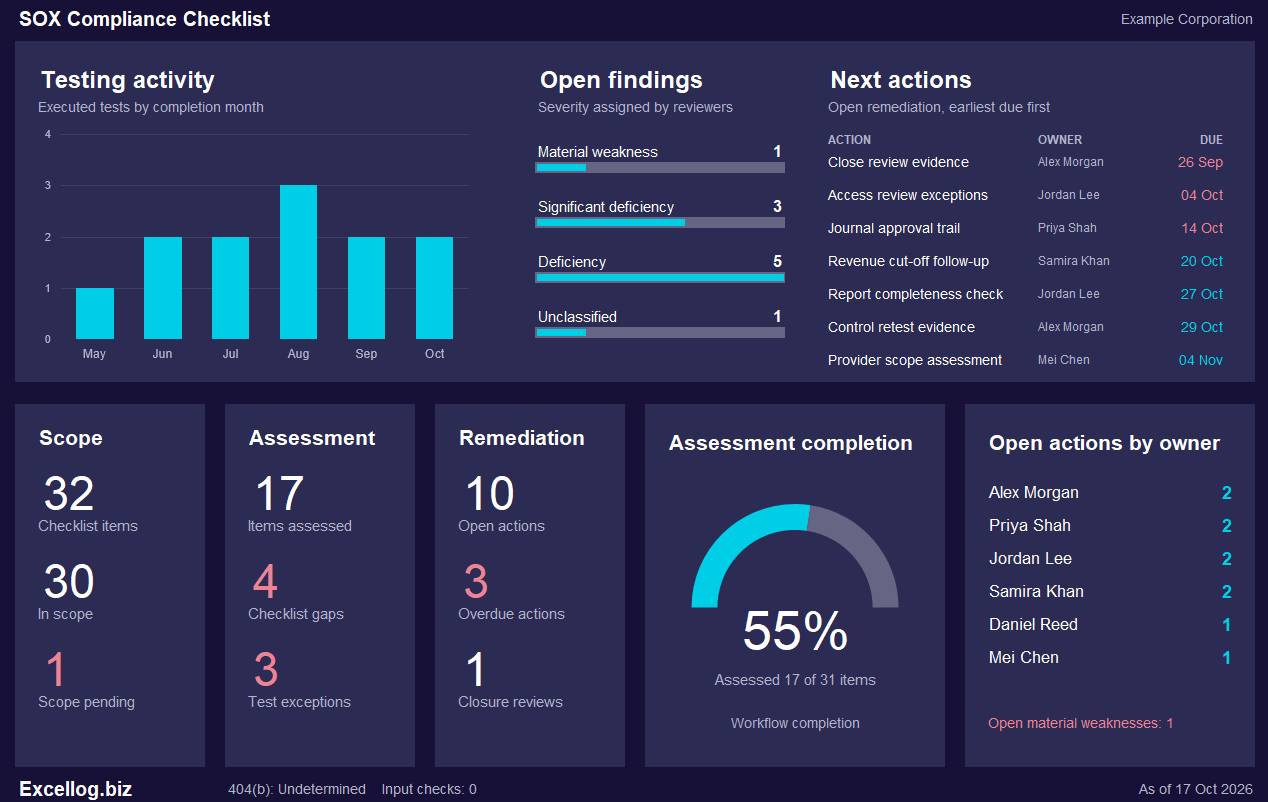
A SOX compliance checklist for internal control over financial reporting starts with the issuer, applicable reporting obligations, reporting period and framework management uses. Confirm the company’s filing status and which management assessment and auditor attestation provisions apply. This guide focuses on financial reporting controls and the work supporting management’s assessment under Section 404. Management and the external auditor have distinct responsibilities.
Begin with a potential financial statement error
A retailer records revenue when goods ship under its applicable accounting policy. The financial reporting risk is that shipments close to year-end are recorded in the wrong period. Define the relevant financial statement assertion, significant account, process owner, systems and source data. Identify the control intended to detect a cutoff error, the level of detail in the review and the evidence retained when the reviewer challenges a transaction.
Check the precision of a review control
Suppose the controller reviews the daily total of shipments against recorded sales and signs a summary at month-end. Two orders of equal value fall into opposite periods and offset in the aggregate comparison. Ask what other checks would detect the individual errors and what information was available to the person performing the review. A signature establishes that someone signed the report. It leaves open whether the review could detect the error of interest.
Document the source and completeness of the underlying report, the review threshold, evidence of investigations and the person’s authority to resolve differences. Use the risk control matrix to link the cutoff risk, assertion and control. In the testing tracker, distinguish a weakness in control design from a failure to carry out a suitably designed procedure.
Bring unresolved matters to the right reviewers
Record the affected accounts, possible magnitude, likelihood, compensating controls and issues that may combine with the identified deficiency. Route the evaluation through management’s established assessment process and involve the appropriate audit or governance participants. Preserve the evidence behind severity judgments, approval and remediation status. A checklist completion percentage gives limited insight into whether an unresolved deficiency could affect the financial reporting conclusion.