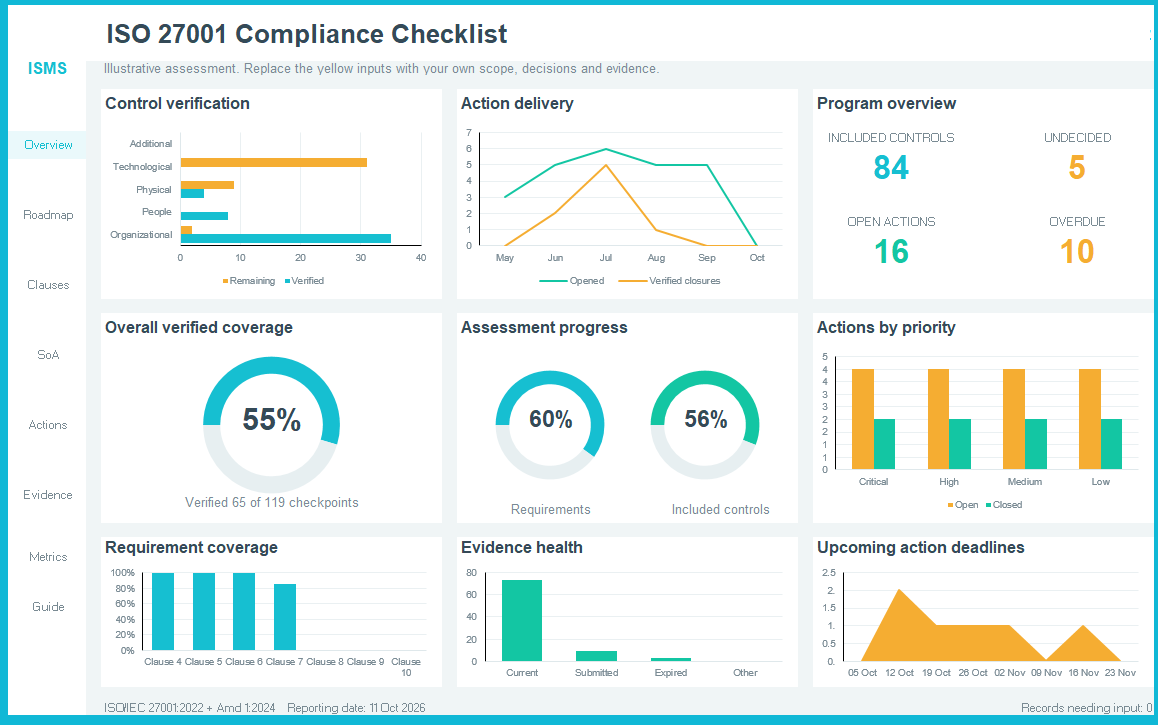
An ISO 27001 compliance checklist helps an organisation examine its information security management system, usually called the ISMS. Start with its scope. Identify the services, locations, people, information and interfaces the system covers. ISO/IEC 27001 sets requirements for the management system and uses risk assessment and treatment to inform control decisions. Review the relevant edition and amendments alongside the organisation’s own scope and requirements when building the checklist.
Follow one risk across the management system
A payroll provider includes its hosted payroll service in scope. A support engineer can temporarily obtain elevated access to repair a processing failure. The risk owner identifies the potential for inappropriate changes to payroll records. The team chooses time-limited approval, logging and retrospective review as treatment measures. Each measure needs an owner, an operating trigger and a record that can be checked. Trace these decisions into the treatment plan and the Statement of Applicability so the selection, rationale and implementation status are clear.
Test the evidence at the boundary
Select a recent support incident and compare the approval window to the access record. Suppose access was approved for two hours but remained active until the next morning. The design description and access policy may be sound, while the incident exposes a gap in operation. Give the gap an owner and agree what will establish that expiry works. The risk treatment plan can record the change, and the control testing tracker can document a subsequent test.
Work through the surrounding management activities as well. Ask when the risk assessment was reviewed, how relevant objectives are measured, what internal audit found and how management considered results. An organisation can possess technically detailed control evidence while still lacking evidence that decision makers reviewed the system.
Present a decision-ready gap list
Review every management system requirement in clauses 4 through 10. Record its evidence source, owner, review date, conclusion and next action. In the Statement of Applicability, identify necessary controls, justify their inclusion, show whether they are implemented and explain any exclusions from the Annex A reference set. Separate evidence still being collected from confirmed shortcomings. Management can then schedule an internal review, address specific gaps or discuss readiness with its chosen certification body. Certification involves a separate assessment by that body.