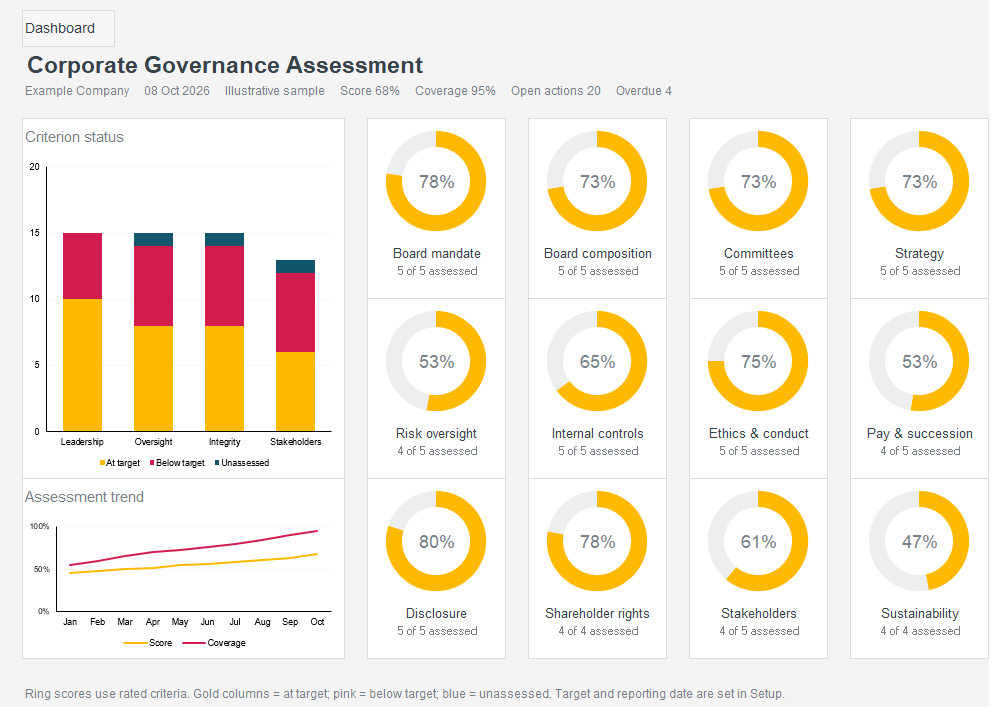
A corporate governance assessment asks whether the people entrusted with oversight can direct and challenge the organization in practice. A board may have a current charter, a committee calendar and timely papers. The useful test is whether someone can trace a consequential decision from the authority to make it through to the result directors reviewed.
Pick decisions before collecting documents
Choose two or three matters with different routes. A capital investment, a related-party proposal and an unresolved service failure expose different parts of the governance system. For each, write an assessment question and the condition that would satisfy it. For example, “Could directors see the cost of delaying the investment?” calls for a comparison in the papers or a record of the question and answer at the meeting.
Use one assessment row for each question. Record the applicable charter or local rule, the decision examined, dated evidence, the assessor’s conclusion and the practical consequence of any gap. Distinguish missing documentation from a decision made outside authority. Either may require action, but the investigation and the responsible person will differ.
Follow a warehouse investment through two committees
Suppose an operations committee recommends a warehouse lease. The board paper shows annual rent of $180,000. The signed commitment covers five years, or $900,000 before other costs. A reviewer compares the referral against the approval rule for multiyear commitments. The correct body approved the lease. However, its minutes asked for a customer-volume sensitivity analysis, and no one can locate the return paper.
Record the finding against follow-up. The company secretary assigns the return paper to the operations director and adds a due meeting to the board decision register. The reviewer can then check whether directors saw the downside scenario and whether it changed the expansion plan.
Report findings directors can resolve
Summarize what worked, which decision remains exposed and who can repair the weakness. Attach the relevant evidence references. Close a finding after reviewing the next comparable decision or the agreed follow-up. That last check shows whether the new practice reached the boardroom.